
Are ceiling fans actually worth it in the UK? Logically they make sense, but should more people install them? Here are my early thoughts on the Philips Olas: what works, what doesn’t, what it cost, and the installation mistakes to avoid.
The short answer is unequivocally yes. In the recent heat wave our bedroom has hit over 30 degrees C. In the past we would not be able to sleep at all well, with the fan I’ve been able to sleep comfortably.
Why I Wanted a Ceiling Fan
I sleep in a south-facing room with a sash window and a Velux. It’s well insulated, which is great in winter, but in summer it turns into something approaching a sauna. Both windows wide open, a fan placed in the gap, air cascading in, yet the room stubbornly stays hot and I stay uncomfortable.
Standard pedestal or tower fans are limited. You have a choice: the air either oscillates back and forth, flapping at you, or it moves in a narrow cone at you along with the noise.
I’ve housesat across the country, across Europe in fact, and experienced all ranges of fans (quite the claim to fame). From fancy Dysons (which are noisy and a bit rubbish) to industrial cage fans (better but loud). All have the same problem: the air is moving rapidly in a narrow stream.
My foray into ceiling fans began as a thought about heating, not cooling. If someone was to try and heat their house with a single aircon unit, how would they push the air downstairs or upstairs? You can install vents, but they’re expensive and disruptive. You could put a small fan at the top of the stairs and try to circulate air, but that would get tedious quickly. So I thought, why not have a ceiling fan that can push massive volumes of air easily and quietly, while being cheap to run and install? That idea still lingers, but since I don’t have an aircon yet, I thought I’d start with a fan.
It’s strange that ceiling fans aren’t more common in the UK. When travelling abroad, staying in hotel rooms across Southeast Asia, the rooms all had one thing in common: a ceiling fan. They’re standard in countries where the heat is known to be stifling. Yet in the UK they’re rare. I think part of it is that our old building stock was poorly insulated and didn’t overheat like modern well-insulated houses do. Possibly it’s aesthetic. Ceiling fans have historically looked terrible, the kind of thing you’d find in a fading hotel bar. Dusty blades swirling around dimly lit, floral glass shades with only two of three bulbs working. Possibly British summers just weren’t historically hot enough. Possibly people just don’t think about them.
For now the air conditioning is waiting. The room clearly needs it. But the ceiling fan felt like an experiment worth trying in the meantime: cheaper, simpler to install, and if it didn’t work I wouldn’t have lost much.
How a Ceiling Fan Actually Cools You Down
Everyone knows a fan makes you feel cooler. On a hot day still air around you warms up, it saturates with moisture, and you stop losing heat. If the air moves, then there is evaporation of your sweat and you cool. You notice this on roasting hot days — it’s when you stop walking that sweat starts to bead.
A tower fan or a desk fan moves a small amount of air fast. A ceiling fan moves more air slower. The latter is more comfortable.
Which Ceiling Fan I Chose: The Philips Olas / CJOY 42 inch
I looked at a fair few. Most ceiling fans, I have to say, are ugly. There’s a kind of institutional dreariness to them. There are a few brands now making nicer-looking fans: Philips, Lucande, Ollyri.
I settled on a Philips Olas, which is the identical model to the CJOY 42 inch.
Philips Olas 42-inch ceiling fan on Amazon
Philips Olas 52-inch ceiling fan on Amazon
Philips Olas Black mount wooden blades
Cjoy 42-inch ceiling fan on Amazon (cheaper better instructions)
Newday 46-inch – looks similar but different (same controller)
Newday 46-inch – similar but different.
Philips Civx – thinner blades different design same remote
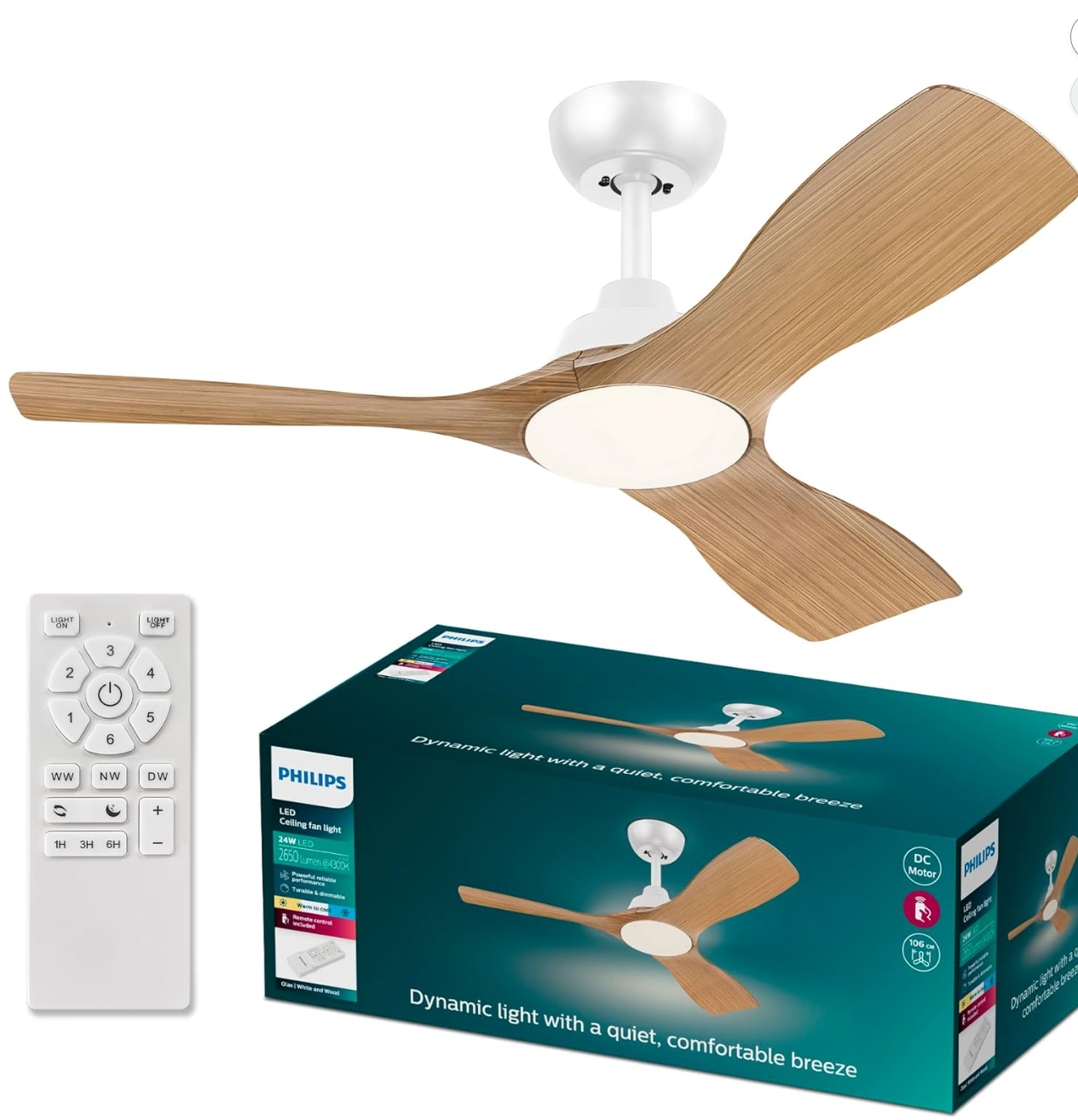
It wasn’t expensive. I paid around £120. Not a lot more than a standing tower fan. The blades are wood-effect plastic, which sounds cheap but turns out to be fine in practice. I don’t look at them enough to notice.
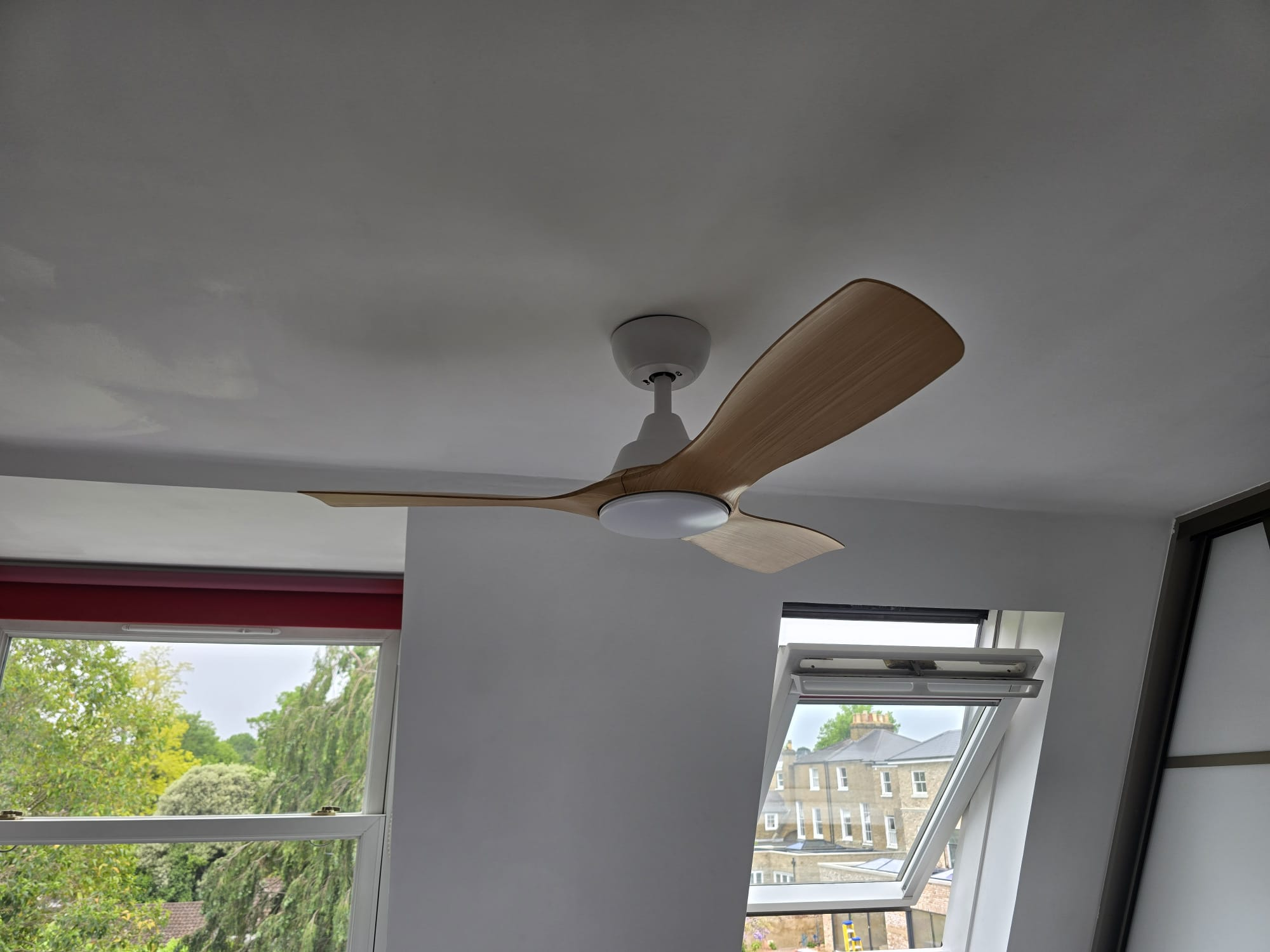
It was on sale, and I think it looks reasonably nice. It’s a 42-inch fan with three blades in white, and it’s got a built-in LED light.
It’s not a beautiful object, but it’s not unattractive either. It doesn’t draw attention to itself. That’s about as much as you can ask from a ceiling fan.
The Built-In Light
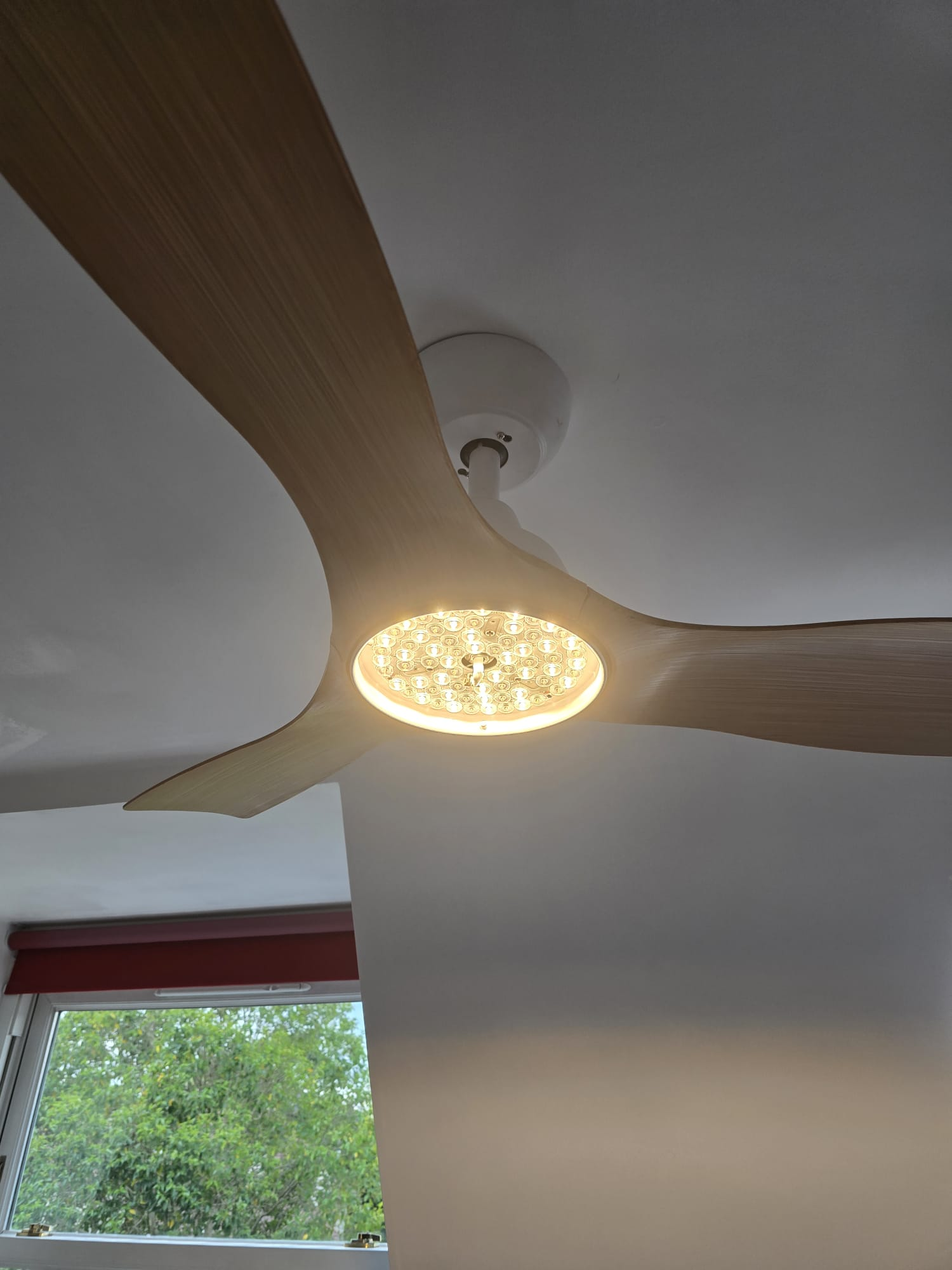
The light was a factor. I wanted something that could replace the existing ceiling fitting. It’s dimmable via the remote, and you can shift the colour temperature from warm white to daylight.
Warm white is the setting I use most. The diffuser helps. It’s a frosted plastic cover that throws light evenly. You wouldn’t want to use it without the diffuser as it has many small LEDs, rather than a bulb.
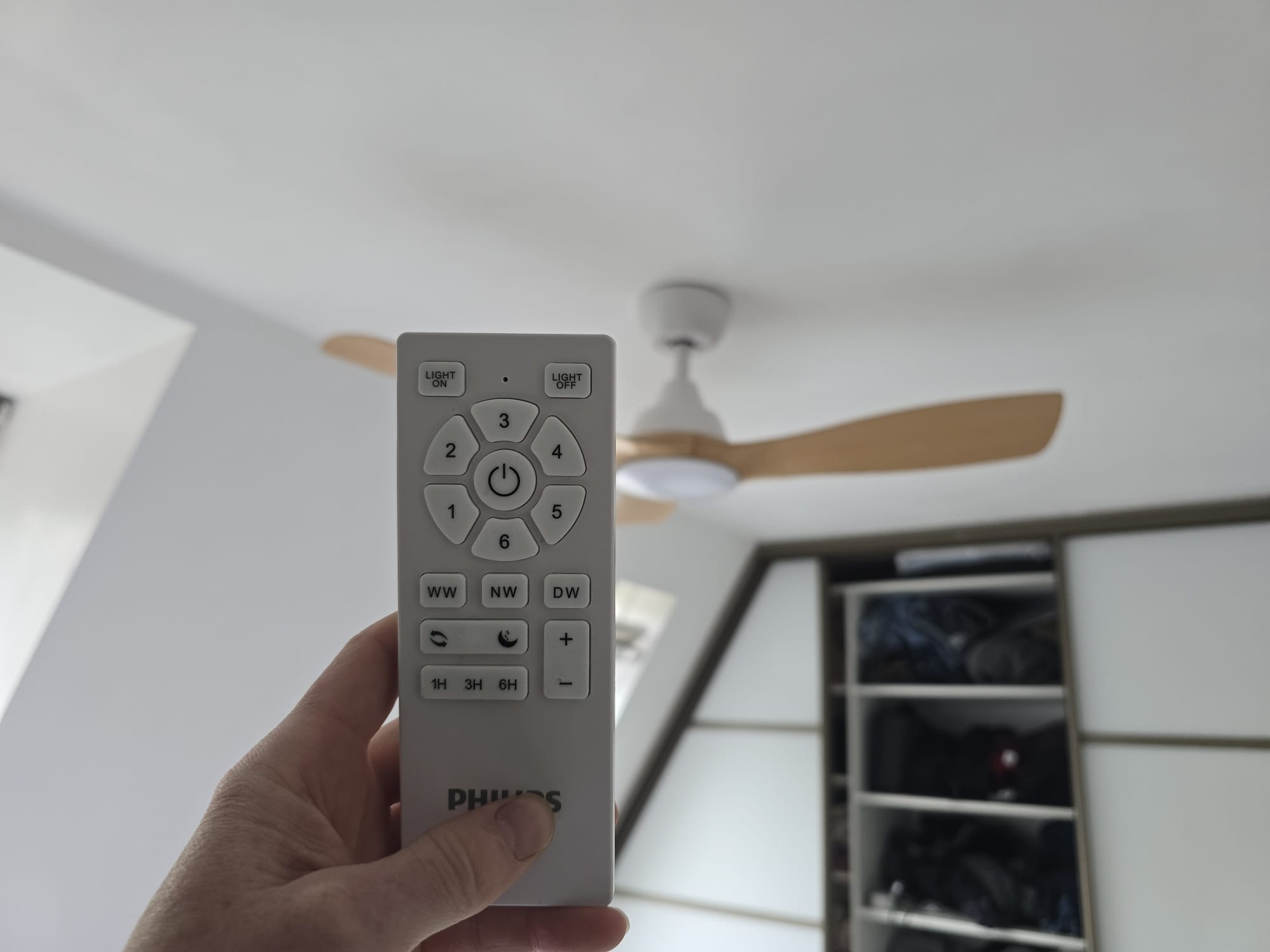
Switching between temperatures is done with the remote. One button cycles through warm, cool, and daylight. Simple, no apps.
The dimming works well enough, though it doesn’t go quite as low as I’d like. At its lowest it’s still bright enough to read by. You can’t use it for that very low ambient glow some people like in the evening. It’s a minor thing.
The remote is relatively large. If you change a setting on the remote then turn the light off at the wall, it remembers the setting you changed. So if you had the fan on and light off, then turned it off at the wall, then turning it back on at the wall would only turn on the fan. You’d have to find the remote to turn the light back on.
How to Install a Ceiling Fan (and Mistakes to Avoid)
It is important to remember that the fan can’t just be screwed into a plasterboard ceiling. It ideally needs a joist or at the very least a wooden board to spread the load. Certain plasterboard fixings may be suitable but most are not. Some testing has been done here if you are unsure.
The installation wasn’t difficult, but it was a faff. The instructions are the main problem. They’re non-sequential in places, and some of the diagrams are genuinely bizarre.
Part of the issue is that some components come preassembled for packaging. You have to take them apart before you can build them back up in the correct order. I can see the logic — the box is smaller — but it adds confusion that could be avoided with better instructions.
The key mistake I made, and the one I’d tell anyone else to avoid, is where to position the mounting bracket relative to the electrical supply. My instinct was to centre it over the cable coming out of the ceiling. This is wrong. There’s a control box that slides into the mount, and if you’re centred on the supply there isn’t room for it. You either need to offset the mount, or cut a small channel in the plasterboard to run the cables through. I ended up doing the latter, which wasn’t the end of the world, but it was irritating.
The screws they supply are worth a mention. I sheared the head clean off one using an impact driver. That shouldn’t happen with a screw going into a ceiling joist. I swapped them out for better ones.
A final irritation: the instructions tell you to assemble the fan then fit the cowling over the mounting. Unfortunately, once you’ve assembled it all, it’s very difficult to unscrew the screws on the mounting that the cowling secures to. Loosen these screws before putting the fan on.
Despite all of this, once it’s up, it’s up. The whole thing took a bit over an hour, including the plasterboard surgery.
Does a Ceiling Fan Actually Help in a UK Bedroom?
Yes. More than I expected.
Before the fan my strategy was simple: open both windows and hope. The air would come in and out, but it didn’t really circulate. It sort of wafted. The walls, the furniture, the floor held their heat, and the room stayed stuffy well into the night.
With the ceiling fan running I can open the windows, ramp the speed up, and the air actually moves through the room. When I come back later the ambient temperature is noticeably lower. Not because the fan cools the air (it doesn’t), but because moving air strips heat from surfaces faster than still air ever can. The walls cool. The room cools. It’s the difference between letting something air dry and pointing a fan at it.
For sleeping, I run it on a low speed and it’s enough. The air moving across the room stops that stagnant feeling you get on hot nights.
There’s also a winter mode, which reverses the direction so it pulls air up rather than pushing it down. The idea is you run it on low and it circulates warm air that’s gathered at the ceiling back down into the room. I haven’t used this in earnest yet, but the logic seems sound.
As of writing this we have had the mega hot days in June, it has been fantastic, we ended up buying a second for the office. I would highly recommend a ceiling fan if you don’t have AC. But also maybe even if you do have AC and want to reduce the load.
How Noisy Is It?
This was one of the main reasons for getting a ceiling fan. I’m noise sensitive. I sleep with foam earplugs. My tower fan, which is marketed as whisper-quiet, produces a low hum on its lowest setting that cuts straight through the earplugs and annoys me. Not loud, just present.
On the ceiling fan’s lowest setting (which is a bit too fast) the ceiling fan is quiet — even quieter than our air purifier running on its silent mode. It doesn’t cut through the earplugs. I don’t notice it.
At higher speeds it begins to almost chop the air like a helicopter. The higher speeds were a godsend during when the bedroom temperature hit a sustained 30 degrees.
The One Thing That’s Not Quite Right
Speed 1, the lowest setting, isn’t slow enough. There are six speeds, and 1 should be a gentle stir of air rather than a definite breeze.
There’s a partial workaround. If you reverse the fan direction so it pulls air up instead of blowing it down, the breeze sensation reduces because you’re not in the direct column of air. You still get the circulation benefit, just without the draught. Most of the time I leave it blowing down anyway. It’s not intrusive enough to bother me. But it would be nice to have a genuinely slow setting for sleeping.
It’s a small thing. But it’s the one thing I’d change.
What I’d Do Differently
Not much, honestly. The fan itself is fine. The installation frustration was mostly down to poor instructions, not the product, and once it’s up you forget about that.
If I were doing the install again, I’d offset the mount from the electrical supply from the start. And I’d loosen the cowling screws before assembling the fan onto the bracket. Two small things that would have saved me twenty minutes of swearing.
Is a Ceiling Fan Worth It in the UK?
For £120, yes. Unequivocally.
It’s solved a real problem (the south-facing room that wouldn’t cool down at night), and it’s done it quietly, without adding another thing cluttering up the floor. It doesn’t demand attention. It just spins and the room is better for it.
Would it replace air conditioning? Probably not, but it would likely mitigate the need for it. On a genuinely hot day, when the outside air is still and warm, moving air around only gets you so far. The room still needs proper cooling at some point. But as a stopgap, and as something that will likely remain useful even once I do get aircon installed, it’s hard to fault.
Part of me thinks ceiling fans should be standard in any UK room that gets a lot of sun. The logic is so straightforward (a large slow fan beats a small fast one) that it’s strange they aren’t more common. I suspect it’s a combination of British pessimism about summer and the fact that most ceiling fans look like they were designed in a municipal building in the 1980s. The newer ones, like this Philips, don’t have that problem. They’re not beautiful but they’re inoffensive, and the integrated light means they replace rather than add to what’s already on the ceiling.
If you’ve got a room that overheats and you’re on the fence, I’d say try one. It’s cheaper and less disruptive than air conditioning, and if it doesn’t solve the problem entirely it’ll still make the room more comfortable than it was.
You can find the Philips Olas ceiling fan on Amazon if you want to take a look at the model I went with.
Frequently Asked Questions
Are ceiling fans worth it in the UK?
I think so, particularly in well-insulated modern homes and rooms that get a lot of sun. UK summers are now hot enough often enough that a ceiling fan earns its keep, and at around £120 for a decent model it’s a fraction of the cost of air conditioning. It won’t replace aircon on the hottest days, but it makes a noticeable difference.
Do ceiling fans actually cool a room, or just move air?
It is said that they don’t lower the air temperature directly, which is true. However, they allow air to circulate better so if the windows are open and it is cooler outside they can help draw in colder air and mix it. Which can cool the walls and furnishings, so I would class that as cooling the room. Obviously, that requires it to be later in the evening when the outside has cooled.
Can you fit a ceiling fan to a plasterboard ceiling?
Ideally, You need to fix into a ceiling joist, or fit a wooden support board between joists to spread the load. A few specialist plasterboard fixings are rated for fans, but most aren’t, so check the spec carefully before relying on one.
Are ceiling fans noisy?
The Philips Olas I fitted is quieter than my air purifier on its lowest setting. At higher speeds you do start to hear the blades chopping the air, but for sleeping you’d never run it that fast.
How much does a ceiling fan cost to run?
Very little.
Why are ceiling fans uncommon in the UK?
Probably a mix of reasons: older British housing stock was poorly insulated and rarely overheated, summers were historically milder, and ceiling fans had a dated aesthetic association with shabby hotel bars. Newer designs from brands like Philips, Lucande and Ollyri have largely solved the looks problem, and warmer summers plus better insulation are starting to make them more relevant.