
I was recently sent some very interesting real-world A2A (air-to-air) monitoring measurements from Daniel Lugosi. He has electricity monitors on a number of different heat pump brands, with his results corroborating something that John Cantor and I had already noticed: there are substantial differences in how units operate across different manufacturers.
With heat pumps, the headline capacity figure only tells you part of the story. I know there have been some recent articles arguing that customers shouldn’t have to think about compressors, and that these things don’t really matter. However, I think this is something installers will need to consider when installing for heating rather than cooling. People have higher standards for heating than for cooling, primarily because an aircon is expected to make some fan noise, but heating systems like radiators are silent — so people are far less tolerant of noise from a heating unit.
A 2.5 kW unit, a 4 kW unit and a 5 kW A2A unit might look easy to compare on paper. You would assume the smaller unit can run lower, the larger unit can run higher, and that everything scales neatly in between. In reality, it doesn’t work like that. It is very dependent on what is inside the heat pump — specifically the compressor and how that compressor is controlled.
Why I Think Minimum Modulation Matters
A heat pump does not simply turn electricity into heat at a fixed rate. A good inverter-driven unit should be able to vary its output depending on the heat demand. Pretty much all A2A units are inverter driven. All that means is that the speed of the compressor isn’t fixed — it can run at a range of speeds, maybe 40% up to 100%.
In mild weather, or in well-insulated rooms, the minimum modulation will dictate how little heat the unit can put into the room before it has to start cycling on and off. This is something manufacturers rarely make obvious in brochures, but I suspect it will make a considerable difference to comfort, noise, efficiency and probably long-term wear.
In cold weather, this is easy enough to understand. The house needs a lot of heat, so the heat pump runs harder. The room might need 1000 W of heat to stay warm at minus 5 outside.
But in milder weather, the room might only need 300 W to stay warm. If the heat pump can only deliver a minimum of 800 W of heat, then it will have to turn on and off a lot (cycling).
That is not necessarily disastrous. Pretty much all A2W units will cycle on warmer days. An air-to-water heat pump usually has water volume, pipework, radiators or underfloor heating which can buffer the heat. Air does not provide the same thermal buffer. If an air-to-air unit is oversized or has a high minimum output, the room can be heated very quickly and the unit must then turn off. It will then have to wait for the room temperature to drop again before switching on. When something is constant, you tend to filter it out; it is when something turns on and off that you notice it. This is especially relevant for air-to-air heat pumps because they heat the room directly.
So I believe the ability to run low and steady is valuable.
What the Measurements Show
Daniel’s first chart compares three smaller units:
- Daikin FTXM25A
- Mitsubishi AP25
- Midea Mission II
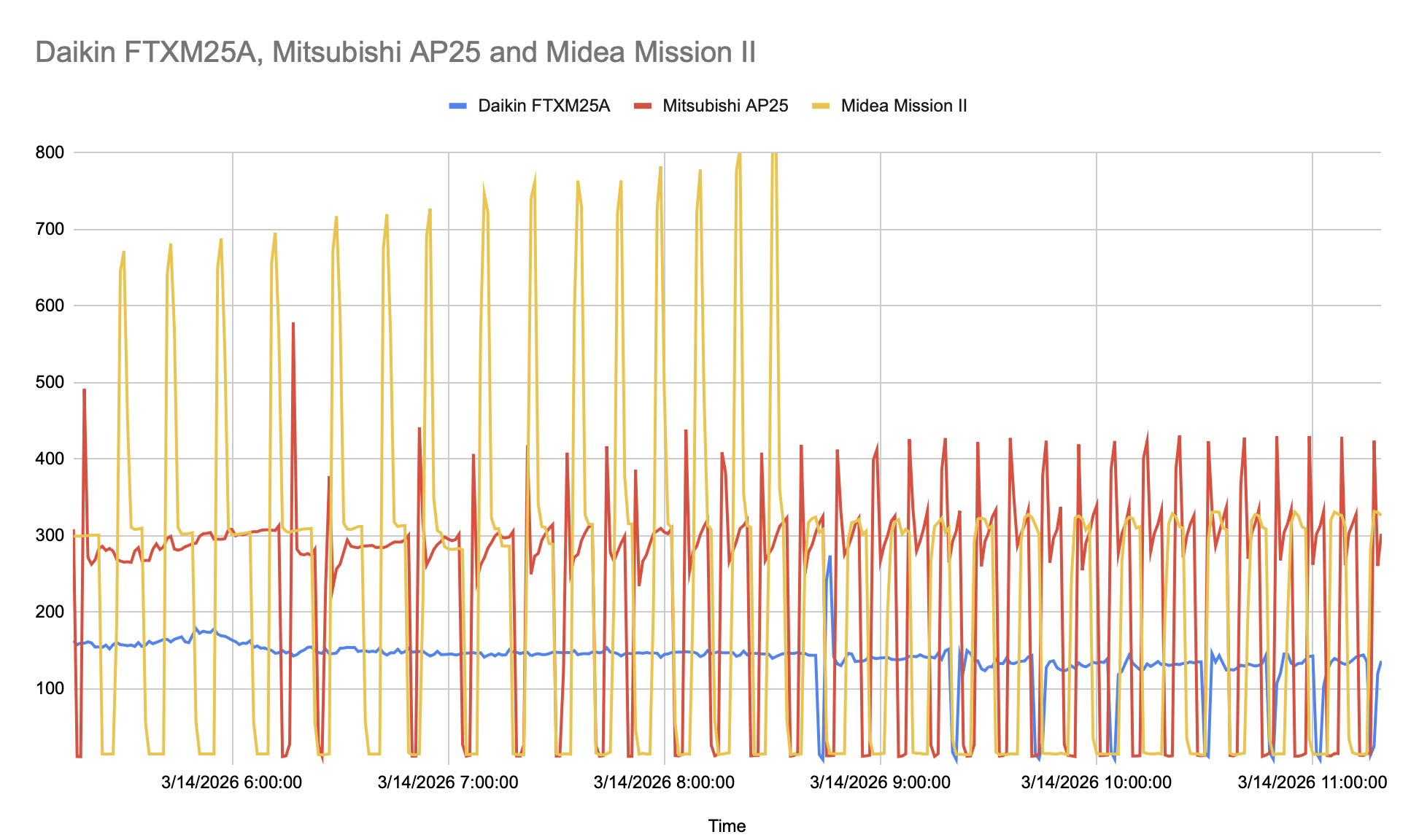
The Daikin appears able to modulate down to roughly 125 W electrical input and sit there steadily.
The Mitsubishi AP25 seems to bottom out higher, around 260–270 W. That is still not excessive, but it is roughly double the Daikin’s lowest observed input.
The Midea Mission II behaves differently again. It shows much more pronounced pulsing, at times starting around 700–800 W, then dropping lower, then repeating. Later in the chart it behaves a little more like the Mitsubishi, but overall it looks less smooth.
That does not automatically mean the Midea is bad. Control logic can be complicated. Outdoor temperature, indoor temperature, fan speed, coil temperature and refrigerant control can all affect behaviour. But from this graph alone, both the Midea and the Mitsubishi AP25 are less refined at low load than the Daikin.
The second chart is perhaps even more interesting. It compares larger units:
- Mitsubishi AP42
- Daikin FTXTM40
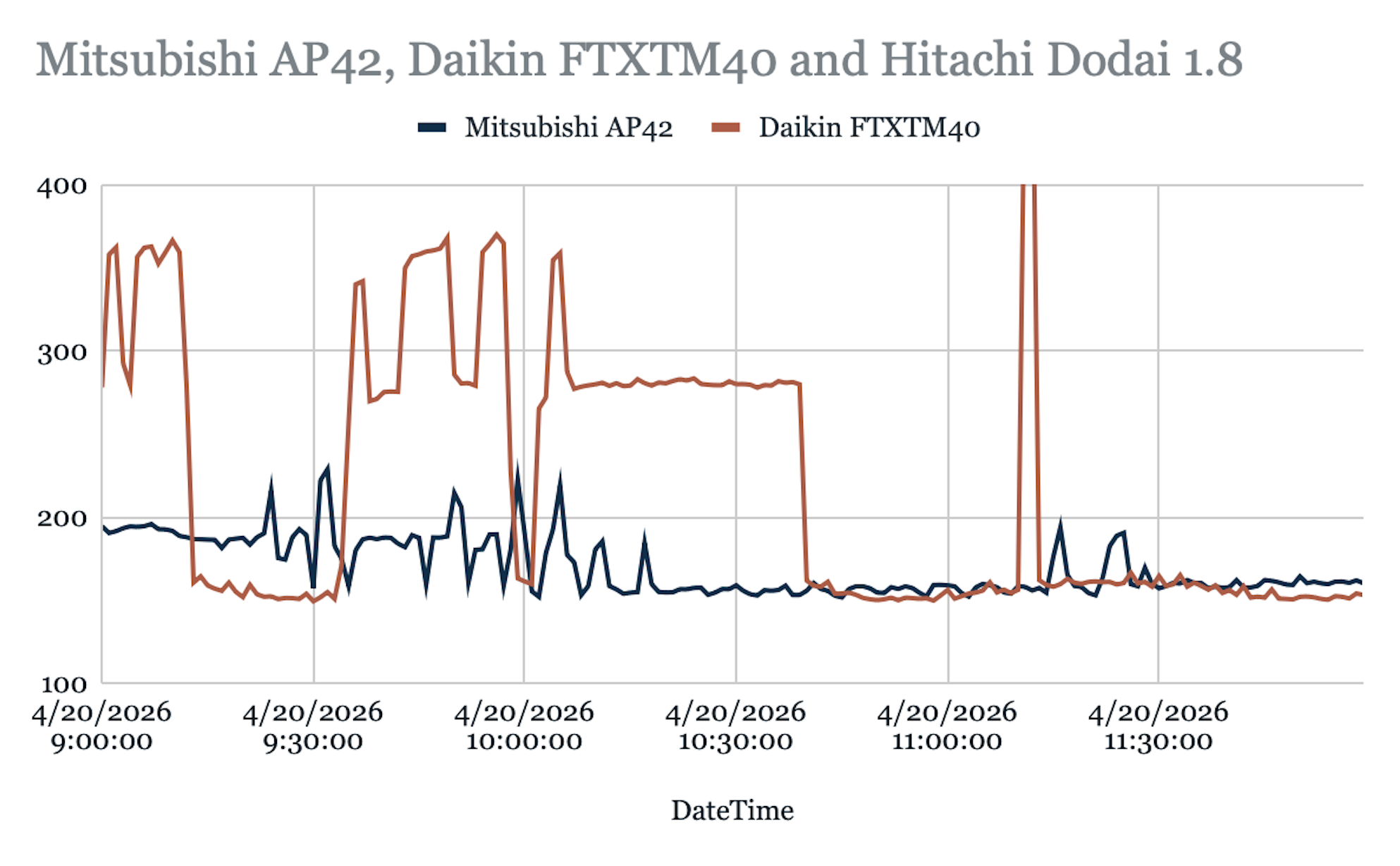
You might expect the larger machines to have a much higher minimum input. But both the Mitsubishi AP42 and the Daikin FTXTM40 appear able to run down at around 150 W. A smaller Hitachi Dodai 1.8 reportedly has a minimum input closer to 350 W.
What I want to get across is that a smaller, “more appropriately sized” A2A heat pump does not automatically mean better low-load modulation and comfort.
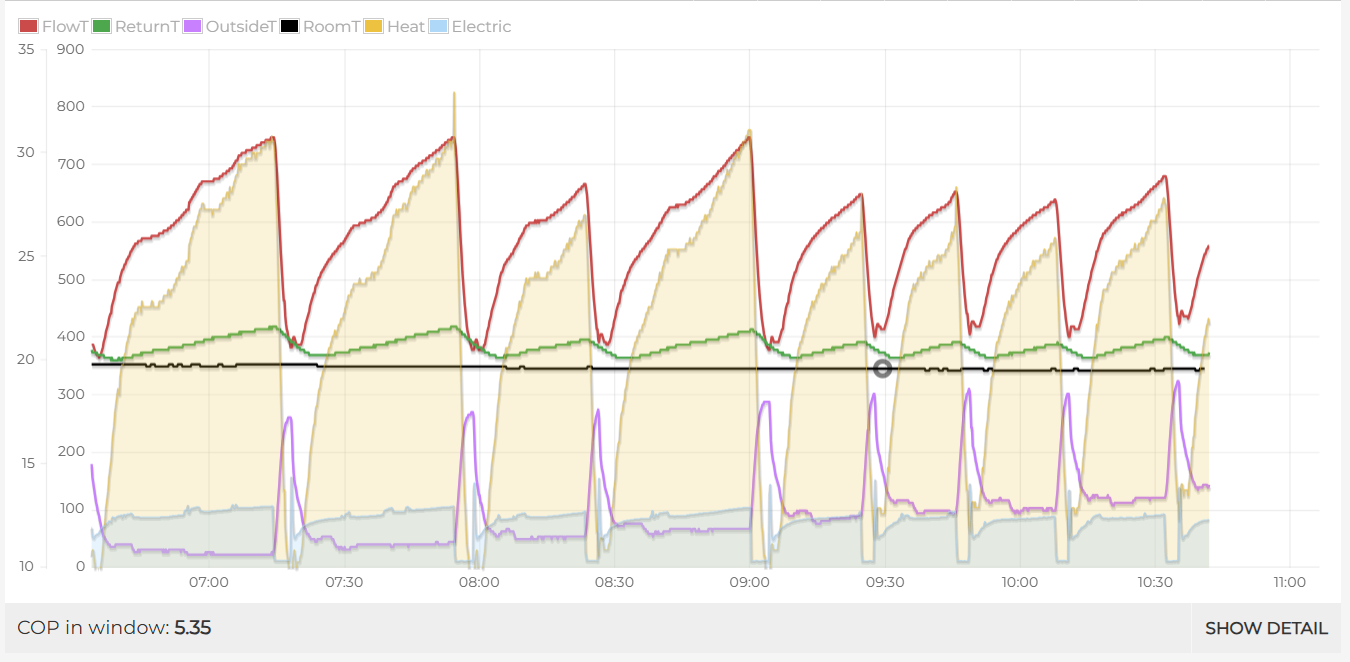
The unit I monitor the Mitsubishi LN35VG2 can modulate as low as 90W in some circumstances. Although, this in itself is oddly variable. It went through a period where it didn’t seem to modulate below 150W, I cannot figure out why this was the case.
Panasonic Etherea Issues
While conducting research for my air-to-air report, I was contacted by an owner of Panasonic Etherea units, Panasonic’s premium consumer range. He was able to provide me with a significant amount of data showing how the unit was running, and how the room temperature was responding.
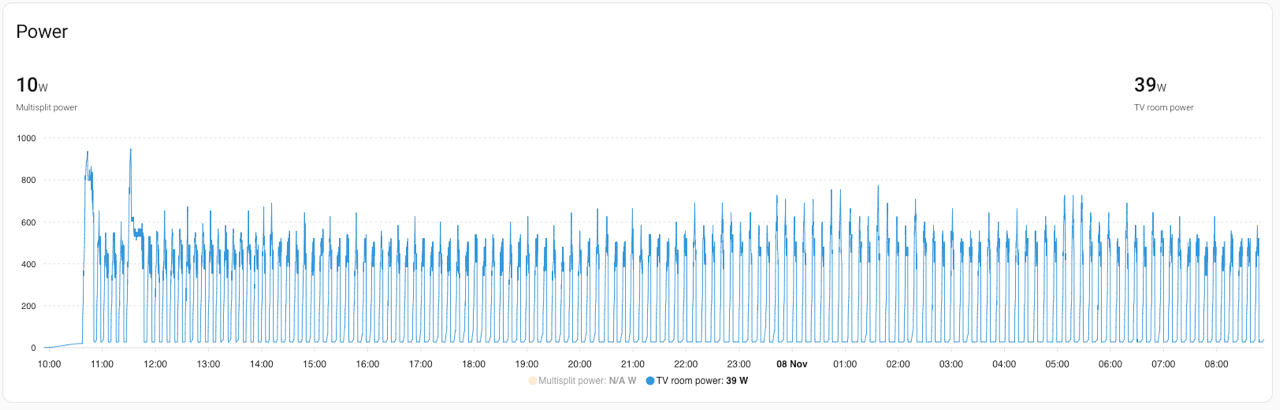
One thing we noticed was that despite being a premium unit, the Etherea appeared poor at modulating. It would cycle on and off, drawing roughly 400 W when on and 0 W when off. If you take the long-term average of these cycles, the figure comes to around 190 W, which is more-or-less what the databook quotes for the unit’s minimum input. However, there is a meaningful difference between 190 W delivered continuously and 400 W delivered in on/off bursts.
This raises an uncomfortable question: how is the quoted minimum input actually being measured? it appears that the minimum input is time-averaged result of this cycling, rather than a true sustained low-power output. A separate source spoke to an Ebac air-to-water rep at a trade show, who confirmed that their minimum quoted figure included cycling. If that practice is widespread, the published minimum-input specs are not useful.
The Etherea seemed to have other issues too. The temperature sensor sits less than an inch above the condenser coils. In heating mode, hot air rises and corrupts that sensor’s reading almost immediately, so the unit “thinks” the room is up to temperature long before it actually is, and shuts off. On cooling mode the same unit behaves completely differently: cool air falls, so the sensor reads something close to actual room temperature, and the unit holds a steady, well-modulated power draw with no cycling. Some owners don’t seem to have this issue, but I have heard from a number that do.
The cycling problem is also worse at low fan speeds, because the hot air isn’t forced away from the sensor quickly enough. Running the fan harder helps, but the higher fan speeds measure above 50 dB at the unit, which is audibly far too loud for domestic heating. So the user is stuck choosing between accurate temperature measurement and acceptable noise.
The unit’s control logic doesn’t help either. In heating mode, the compressor turns off when the intake-air temperature sensor exceeds the internal setpoint by more than 2°C for three minutes, and turns back on after another three-minute wait, on when intake-air temperature falls. There is no PID control, instead it is a hysteresis threshold with a built-in 2°C overshoot.
Panasonic does not provide an official method for using a wall-mounted thermometer with these units, so the homeowner essentially had to build his own Home Assistant control system. This sets an artificially high target internal temperature — so the unit’s own sensor never reaches it — and switches the unit on and off based on a thermostat elsewhere in the room. This works, but it gives up what modulating ability the unit has.
The manufacturer has been unreceptive in assisting with this issue, unfortunately. And it isn’t a one-off: I have since spoken to another Etherea owner with the same problem, and I have heard of similar (though less severe) behaviour on Toshiba Haori units. Owners are typically left to work around the issue themselves, often by running the units at constant high setpoints to defeat the internal logic. You can adjust the ‘temperature offset’ in many of these units, which can help in some cases, but in others it causes the room to overheat. Which defeats the purpose.
The Missing Specification
What I would really like to see is a better database of real-world minimum modulation behaviour.
Not just:
This is a 2.5 kW unit.
But:
This unit can run continuously at around 120–150 W electrical input under mild heating conditions — without cycling.
That would be genuinely useful information for sizing and selection.
At the moment, this kind of knowledge mostly comes from enthusiasts measuring their own systems. That is why Daniel’s data is so interesting.
It also shows why brand and model range matter. A cheap small unit may not have the same modulation ability as a more expensive larger one. A cold-climate unit may have a surprisingly wide operating range. The compressor and controls matter at least as much as the nominal capacity. and in the worst cases, as with the Panasonic Etherea and the ElectriQ unit that John Cantor has written about, the temperature-sensing hardware matters too.
Bigger Is Not Always Worse…
With A2W heat pumps, it is typically best not to significantly oversize, as it increases costs and sometimes reduces efficiency and comfort. With A2A split systems (not multi-splits no data on these yet), it appears that in some cases (for some manufacturers) it may be advisable to “size up” to get a unit that can modulate better. Assuming you can pick the right unit.
That is slightly annoying, because it means you cannot just look at the capacity number and make a decision. You need to know something about the compressor, the control strategy and the minimum stable output.
Unfortunately, that information is often difficult to find. Manufacturers will usually publish rated heating capacity, maximum heating capacity, COP, SEER, SCOP, sound pressure, pipe lengths and operating temperature ranges. But the real-world minimum stable input is not always clear. Where minimum heating capacity is listed, it may not tell the full story. Two units may both claim a low minimum heating output and behave very differently in practice — and as discussed above, the quoted figure may well include cycling.