
Building nuclear power stations in the West has become expensive, but the reasons for that expense are not intrinsic to nuclear power. Part of the problem is that the previous generation of reactors lasted so long that, by the time they needed to be replaced, many of the people who had designed and built them had retired or died. Much of the practical knowledge gained from constructing those reactors had been lost.
In Europe, this has contributed to a disconnect between designers, engineers and builders. Designers may sit in an office and produce a reactor design that can generate electricity and meet all the relevant regulatory requirements. Other stakeholders will also have their own requirements. Over time, these requirements evolve and new elements are added to the design. The result can be a sprawling and complicated structure rather than a concise design that is easy to build.
The clearest example is the European Pressurised Reactor, or EPR, versions of which have been built or under construction at Hinkley Point C, Flamanville, Olkiluoto, Taishan and Sizewell C.
People often point to the EPR project at Hinkley Point C and say: “Nuclear energy is expensive. There is no learning curve, and it will remain expensive.” That criticism ignores why this particular reactor design became so expensive.
Why the EPR became so complicated – the Germans
During the EPR’s concept phase, German utilities wanted important safety systems to be maintained while the reactor remained at full power – this was before Germany phased out nuclear power. This contributed to the adoption of four independent safety trains. A safety train is a complete set of equipment capable of performing a safety function, including pumps, pipes and valves, together with the electrical supplies, controls and supporting systems needed to operate them..
The trains had to be physically separated so that a fire, flood or other local failure could not disable several simultaneously. Each was therefore housed in a separate safeguard building with its own equipment, cabling, ventilation and electrical supplies. This improved redundancy and allowed one train to be unavailable for maintenance, but significantly increased the size and complexity of the nuclear island.
Maintenance at full power required a “two-room” concept within the inner containment structure, dividing the reactor building into an inaccessible equipment compartment surrounding the primary circuit and an accessible service area. This allowed certain maintenance activities to be performed at power, reducing the work required during refuelling outages. However, it required additional internal shielding walls, controlled access routes, closures and complex ventilation arrangements.
Separate from this internal division, the EPR also employed a double-wall containment structure. A prestressed-concrete inner wall formed the pressure-retaining containment, while a reinforced-concrete outer wall protected the reactor against external hazards. The annular space between them had to be maintained below atmospheric pressure and ventilated so that leakage through the inner wall could be collected and filtered. This added further concrete, reinforcement, formwork and ventilation equipment.
The European Pressurised Reactor was therefore a flawed design from the start. It incorporated operating and safety requirements whose construction consequences were underestimated. Individually defensible decisions accumulated into a design that proved exceptionally difficult to deliver with Europe’s weakened nuclear supply chain. Its designers had overlooked a basic fact: complexity is easy to add on a computer, but difficult to build in real life.
People point to Hinkley Point C and say, in effect, “Gotcha! nuclear power is expensive.” but before Hinkley Point C had began construction, there were delays at EPR projects in Finland, France and China. It was a questionable decision to assume that the UK, the global hub of delays, cost overruns and regulatory requirements would not suffer similar problems.
France builds the EPR2; Britain builds the EPR
Many of the EPR’s problems have been addressed in the EPR2. The basic reactor design and an electrical output of approximately 1.67 GW have been retained, but the surrounding plant has been reorganised to make it easier to build.
The EPR2 uses three safety trains rather than four. Preventive maintenance on frontline safety systems will instead take place while the reactor is shut down.
The “two-room” concept has also been removed. This simplifies the arrangement of internal walls, radiation protection, access routes and ventilation systems within the reactor building.
Double containment has been replaced by a single prestressed-concrete containment structure with an internal steel liner. This eliminates the annular space between the containment walls and the ventilation equipment associated with it.
The Nuclear Auxiliary Building has also been removed. Its functions have been transferred to the Fuel Building and the Waste Treatment Building, with the latter shared between two reactors at sites built as twin units.
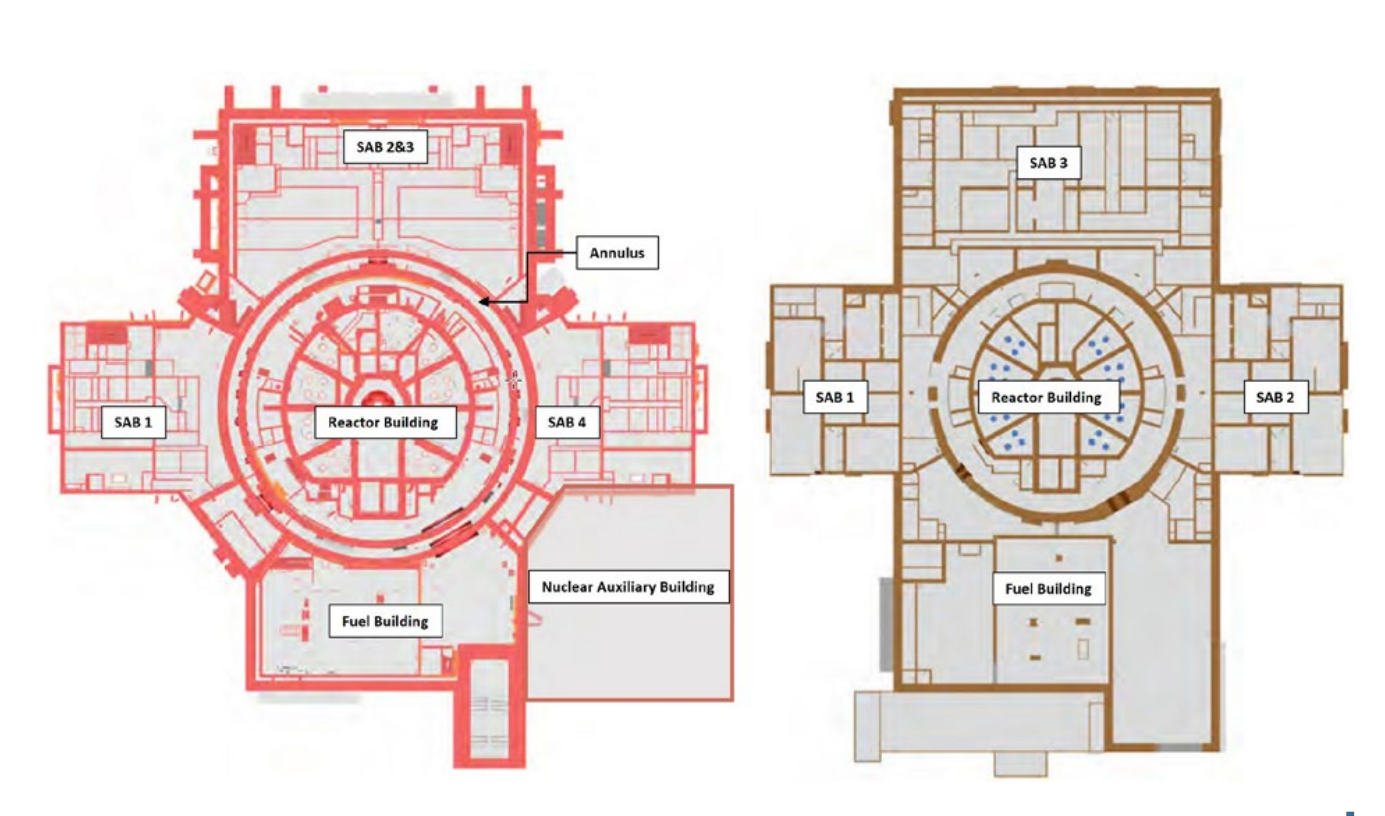
Figure 1. Comparison of the principal buildings in the EPR, left, and EPR2, right. The EPR2 has fewer structures and a more regular layout. The annulus and Nuclear Auxiliary Building have been removed, while the four safeguard buildings have been reduced to three. Source: Mykhaylo Gopych, “The EPR2: A Short Presentation”, 2024.
It is easy to see from the figure that the second structure is far simpler. The internal walls are more regular, the double-containment structure is gone and the overall design is more buildable.
The EPR2 therefore shows how nuclear construction costs may be reduced through design. Fewer structures, more regular layouts and less complicated systems mean less concrete formwork, reinforcement, cabling and ventilation equipment. This reduces both material requirements and the amount of work that must be carried out on site.
EDF also intends to use more standardised components, prefabrication and modular construction. Building the reactors as a series of twin units should allow the same designs, components and construction methods to be used repeatedly. The EPR2 is therefore not simply a modified reactor. It is an attempt to restore the connection between reactor design and practical construction.
France has chosen to simplify the reactor design through the EPR2, whereas Britain will attempt to capture the benefits of repetition by building two further UK EPRs at Sizewell. Switching to the EPR2 – a more buildable design – would clearly be the logical choice. But it would also require a new UK licensing process, new detailed engineering and changes to a supply chain that has recently gained experience of constructing the existing design. Sizewell C will therefore test whether replication can overcome enough of the original EPR’s complexity to make the design economical. China’s decision provides a warning. When the second phase of Taishan was approved in 2025, the authorities selected two domestic Hualong One reactors rather than further EPRs.
The cost lies in inefficiencies
The cost of recent Western nuclear projects does not prove that nuclear power is fundamentally expensive. It proves that those particular projects were expensive. To understand why, we must consider how they were designed, manufactured and built.
Large construction projects struggle to improve without a feedback loop. A reactor must be designed, built and then examined to find which parts caused delays or proved difficult to manufacture and install. Those lessons must then be used to simplify the next reactor. Reactor two at Hinkley Point is being built 20 – 30% faster than Unit 1, so the repetition benefit has been substantial.
In the West, we have a tendency to do stop-start construction. The UK, historically, has designed and built a reactor, set about constructing it in an extremely inefficient manner, found it expensive, stopped building them and allowed the workforce and supply chain to disperse. Years later, we begin again with another unfamiliar design. We build a reactor, discover that it is difficult and expensive, fail to build another, forget how to build it and then repeat the process.
The cost of building anything comes partly from its materials and partly from the work needed to turn those materials into a finished product. The material itself may be relatively cheap. Processing it, moving it, installing it, inspecting it and documenting the work can be expensive.
Suppose, for example, that a tonne of steel costs £1,000. Producing standard lengths of reinforcing bar in a factory is comparatively simple. The expensive part is the labour required to cut, bend, position and weld or tie thousands of pieces into reinforcement cages.
The same principle applies throughout a nuclear power station. A pipe, cable or valve may not be particularly expensive by itself. Its final cost also includes the engineering needed to specify it, the work required to manufacture and install it, the inspections needed to verify it and the documents required to show that it meets the design. Complexity increases all of these costs.
This is also where large savings are possible. A mature manufacturing process moves work away from labour-intensive assembly on site and towards repeatable production under controlled conditions.
Plastic injection moulding provides a simple illustration. Machining each plastic component by hand would be slow and expensive. A mould and injection-moulding machine require a large initial investment, but once that equipment is in place, it can produce thousands of identical parts quickly. As production continues, the cost of each part moves closer to the cost of its material.
A nuclear reactor cannot be manufactured as simply as a plastic component, but the same economic principle applies. Standardised parts, factory production, prefabricated modules and repeated construction reduce the amount of labour required for each unit. Workers become familiar with the design, manufacturers improve their tooling and mistakes found in one project can be removed from the next.
This does not mean that a reactor will ever cost only as much as its raw materials. It means that a mature construction programme can reduce the additional cost created by unfamiliar designs, inefficient working methods and excessive on-site labour.
The important question is therefore not merely how much the first reactor costs. It is whether the programme is organised to allow learning, so that the second reactor costs less to build and the third costs less again.
Repetition can make EPR construction faster, but it cannot remove the many of the constraints inherent in the design. This is one reason why the French revised it to create the EPR2.
This feedback loop, combined with a simpler design, is also one of the reasons why small modular reactors are appealing.
Why small modular reactors are appealing
In discussions about nuclear power, economies of scale are often treated as though they simply mean making each reactor larger. A larger reactor is then assumed to represent better value for money because it produces more electricity. People talk about economies of scale, but economies of scale come from building many copies of the same thing and getting good it it, not from building one massive thing.
Therefore, a programme that constructs a series of smaller reactors creates repeated opportunities to improve the design, manufacturing process and construction method. Small modular reactors, such as the Rolls-Royce SMR, may address many of the problems associated with recent large-reactor projects. We know that very large construction sites are difficult to manage, particularly in the UK, where nuclear projects face onerous safety, regulatory and documentation requirements. As a project grows, so does its workforce, the number of contractors and the burden of coordinating their work. More time is spent managing access, inductions, inspections, interfaces and safety procedures. On modern large building sites, a new worker might have to wait two weeks or more for a site induction, and cannot start work until then. A smaller reactor that requires less work on site, because more of it is manufactured in factories, makes it easier to identify where delays and mistakes occur, but can also avoid the challenges of managing extremely large sites.
Large projects also suffer from the human limitations of their workforce. A bigger team will usually experience more turnover during construction, meaning fewer people remain for the entire project. A worker may spend most of a career helping to build only one or two large reactors and have little opportunity to apply what was learned.
A programme of smaller reactors would allow teams and suppliers to repeat the same job more often. Problems found in one unit could be corrected in the next, while tools, factory processes and installation methods could be refined over time. Repetition is how people, organisations and industries become good at building things.
Smaller reactors should also take less time to build. This matters because a large part of the cost of a nuclear project comes from financing. Interest on loans accrues throughout construction, while the reactor is not yet operating or earning revenue. Delays increase the final cost even when the physical reactor itself does not change.
The UK government has attempted to address financing issues through the Regulated Asset Base model, but changing how a project is financed does not eliminate the costs that accumulate during construction.
A shorter construction programme reduces the period over which interest accrues and limits the financial consequences of delays. It also reduces the amount of capital at risk in any single project and allows investors to receive a return sooner. Lower risk can lead to lower interest rates and lower overall costs.
An SMR is not automatically cheap merely because it is small. It may have a higher construction cost per megawatt than a large reactor when considered as a single unit. Its advantage is that a programme of many smaller reactors creates repetition, makes better use of factories and specialised tooling, and allows improvements to be carried from one unit to the next.
Shorter construction times, lower financing risk and a faster feedback loop can reduce costs across the fleet. Instead of betting everything on a small number of enormous projects, an SMR programme can improve through repeated construction.
The extraordinarily high cost of recent Western nuclear projects is not an immutable characteristic of nuclear power. It reflects a combination of demanding reactor designs, immature projects, weakened supply chains, inefficient construction and expensive financing.
The EPR2 shows how a large reactor can be simplified by removing simplifying buildings, systems and operating requirements. Small modular reactors offer another route: smaller projects, greater factory production, shorter construction times and more opportunities to learn.
If we design reactors around how they will actually be built, maintain stable construction programmes and apply the lessons from each unit to the next, nuclear power will become cheaper.